Sunday, April 22, 2012

The Art of the Lathe

The Art of the Lathe Review


B.H. Fairchild’s The Art of the Lathe is a collection of poems centering on the working-class world of the Midwest, the isolations of small-town life, and the possibilities and occasions of beauty and grace among the machine shops and oil fields of rural Kansas.


Saturday, April 14, 2012

Modern American lathe practice; a new complete and practical work on the "king of machine shop tools," the American lathe. Giving its origin and ... as manufactured by different builders ... etc

Modern American lathe practice; a new complete and practical work on the "king of machine shop tools," the American lathe. Giving its origin and ... as manufactured by different builders ... etc Review


This is a reproduction of a book published before 1923. This book may have occasional imperfections such as missing or blurred pages, poor pictures, errant marks, etc. that were either part of the original artifact, or were introduced by the scanning process. We believe this work is culturally important, and despite the imperfections, have elected to bring it back into print as part of our continuing commitment to the preservation of printed works worldwide. We appreciate your understanding of the imperfections in the preservation process, and hope you enjoy this valuable book.


Tuesday, April 10, 2012

Lathe And Planer Tools, Standard Shop Tools and their Use, Cutting Speeds and Feeds

Lathe And Planer Tools, Standard Shop Tools and their Use, Cutting Speeds and Feeds Review



A comprehensive guide produced in 1912 for the Machinery’s Reference Series, and designed specifically for students of engineering. The book is written in easy to understand language and each stage is illustrated with line drawings. A guide to how it was done before the world of computers!
Divided into 5 chapters, the book covers the following:

CHAPTER I CUTTING TOOLS FOR PLANER AND LATHE
Rake of Planer Tools
The Cutting Edges of Lathe Tools
Rake and Clearance
Grinding
Speeds and Feeds
Miscellaneous Lathe Tools
CHAPTER II BORING TOOLS
Holding the Work tightly Against the Center
Difference Between Inside and Outside Turning
Common Type of Boring Tool
Boring-tool Holders
Boring Bars
Boring out Tubes
CHAPTER III FORGING LATHE BORING TOOLS
CHAPTER IV -SHAPE OF STANDARD SHOP TOOLS
Standard Tools
Elements Considered in Adopting- Standard Tools
Relative Importance of the Elements Affecting the Cutting: Speed
Advantages of Bound-nosed Tools
Object of Having the Cutting Edge of Tools Curved
Advantages and Disadvantages of Broad-nosed Tools
Influence of Small Radius of Curvature on Chatter
Relation Between Cost of Forging- and Grinding
Length of Shanks of Cutting1 Tools
CHAPTER V CUTTING SPEEDS AND FEEDS FOR LATHE TOOLS
Making Straight Forming Tools
Use of Second Master Former
Making Concave Forming- Tools in the Milling- Machine
Computing: Dimensions for Forming: Tools
Circular Forming Tools
Formulas for Circular Forming Tools
Charts for Dimensions of Forming Tools

Friday, April 6, 2012

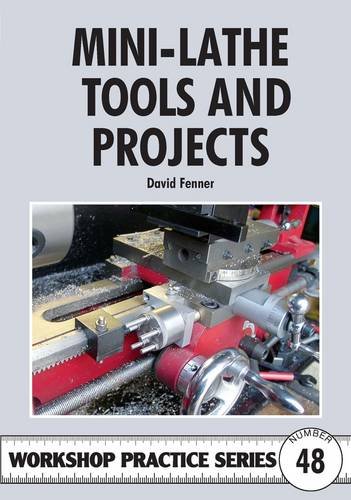
Mini Lathe Tools & Projects (Workshop Practice 48)

Mini Lathe Tools & Projects (Workshop Practice 48) Review


The Mini-Lathe has become the best-selling item of machinery in the hobby engineering market - often purchased as a first step by beginners to the hobby. This book follows on from the same author's introduction to the Mini-Lathe (Workshop Practice Series No. 43) and presents a series of projects which are intended to extend the versatility of this little machine. In some cases, additional machining capacity will be required, which some readers may find at their local model engineering club. The book covers the Mark 2 Mini-Lathe, and specific tools such as the radius turning attachment, the tailstock and the dividing head, and includes techniques such as taper turning and knurling. Whilst specifically written for the Mini-Lathe, some of the projects can equally be applied to other small model engineering.


Wednesday, April 4, 2012

Wood Lathe Projects for Fun & Profit (Schiffer Book for Woodworkers)

Wood Lathe Projects for Fun & Profit (Schiffer Book for Woodworkers) Review


Wood Lathe Projects for Fun & Profit (Schiffer Book for Woodworkers) Feature

  • ISBN13: 9780887406751
  • Condition: Used - Very Good
  • Notes: 100% Satisfaction Guarantee. Tracking provided on most orders. Buy with Confidence! Millions of books sold!
Wood speaks to Dick Sing. With his skill as a woodturner, and his keen understanding of both the lathe and the wood, Dick has created a number of projects which offer something a little different. In this new book, he leads the turner through four projects which are easy enough for the beginner and fun enough for someone with experience. They also are very successful at craft shows. With step-by-step instructions illustrated with clear full-color photographs, he helps the turner discover the shape of a delightful little clock holder in a piece of wood and turn out a finished piece which would add character to any desk or table. He also provides instructions for a candle dish, a desk set with a base, a pen, and a letter opener, and a bookmark. Each project is covered completely, including numerous tips on style and finishing techniques, and a knowledge of wood, including some exotic woods which make striking finished projects.


Saturday, March 31, 2012

The Pattern Maker's Assistant; Embracing Lathe Work, Branch Work, Core Work, Sweep Work, And Practical Gear Construction; The Preparation And Use Of ... Collection Of Useful And Valuable Tables.

The Pattern Maker's Assistant; Embracing Lathe Work, Branch Work, Core Work, Sweep Work, And Practical Gear Construction; The Preparation And Use Of ... Collection Of Useful And Valuable Tables. Review


Many of the earliest books, particularly those dating back to the 1900s and before, are now extremely scarce and increasingly expensive. We are republishing these classic works in affordable, high quality, modern editions, using the original text and artwork.


Wednesday, March 28, 2012

From Lathes to Looms: China's Industrial Policy in Comparative Perspective, 1979-1982

From Lathes to Looms: China's Industrial Policy in Comparative Perspective, 1979-1982 Review


For more than three decades, all manner of critics of socialist states — non-socialists and socialists alike- have excoriated one of the most unfortunate consequences of the Stalinist-style command economy: its proclivity to favor heavy industry over other economic sectors. Ironically, these systems set up in the name of "the people's" interest shortchanged their constituents' livelihood, as factories and foundries spewed out an endless stream of machinery and metals at the expense of consumer items and daily necessities.

In the late 197o's, after the death of Mao Zedong, Chinese leaders were able openly and soberly to scrutinize their faltering industrial system. Under the determined leadership of Deng Xiaoping, they quickly altered the proportions of industrial output in favor of consumer goods. The Chinese leaders had two chief economic goals: to increase the financial returns to the central government and to lay the foundation for a reoriented future pattern of national growth that would give China a secure niche in world markets. They also hoped to open up new employment channels and to meet mass needs for consumer goods. This study shows why and how these goals were chosen and spells out how they were realized.

Though there is no evidence of conscious borrowing, in its vision and tactics the agenda the Chinese leaders chose was highly resonant with what is elsewhere labeled "industrial policy." For this reason, the book draws on the literature of industrial policy in France and Japan, where this form of policy first took root, rather than adopting the more conventional model of comparative communism.

The book uncovers striking similarities between China's post-1979 plan and what occurred in France and Japan after World War II, at the level of elite perception and goals and in societal, behavioral terms. These similar conditions- in context, decision-making pattern, and implementation style provide the framework of analysis for this volume, a framework that could be applied to ex-colonial and dependent Third World economies as well as to more authoritarian socialist planning systems.